Module 2: Video Analysis builds upon the data foundation by introducing the most powerful feedback tool in a coach’s arsenal: the visual replay. In the fast-paced world of sports, the human eye cannot capture every detail. This module addresses the disconnect between what an athlete feels they are doing and what they are actually doing. Rather than focusing on expensive cinematic production, the module adopts a narrative-driven learning approach. By following the journey of “Coach Malik,” the training demonstrates how a simple smartphone camera can act as an impartial mirror, transforming subjective debates into objective learning moments.
The module is structured to guide the learner through the lifecycle of visual feedback, identifying specific clarity points at each stage:
1. The Scenario: The Disconnect and The Debate
The story begins with Coach Malik, who is frustrated with his team’s defensive spacing. Despite his constant verbal corrections during practice, the errors persist in scrimmage.
- The Trigger: During a key drill, a defender leaves a gap open, leading to a goal. Malik stops the play to correct the positioning.
- The Conflict: The player defends himself, insisting, “I was in the right spot! I was covering the line.”
- The Barrier: Without visual proof, it becomes Malik’s word against the player’s perception. This “he-said, she-said” dynamic often halts player development and creates friction within the team.
2. The Application: The Digital Mirror
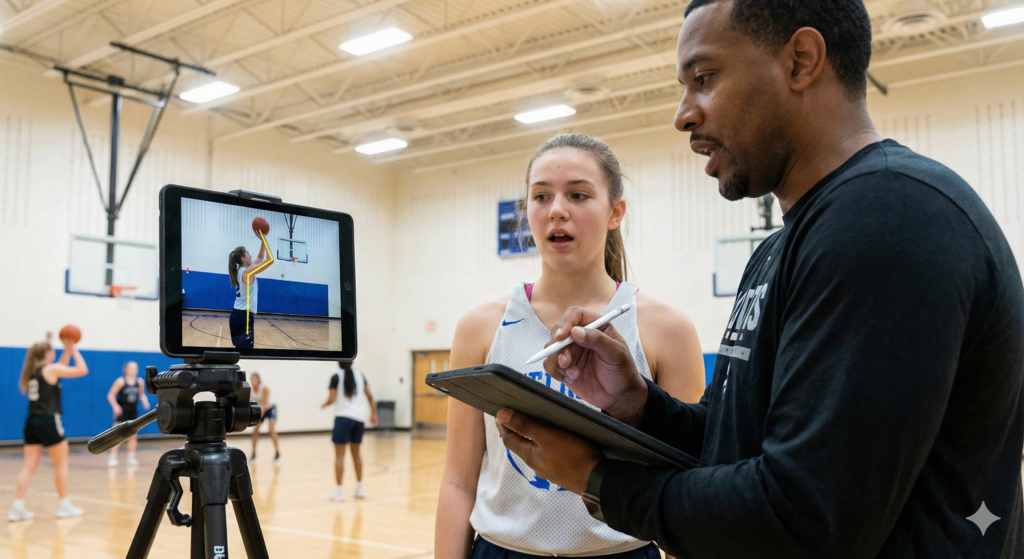
Malik decides to implement the Novice Level techniques from the FutureCoach curriculum. He sets up his tablet on a simple tripod to record the next session.
- The Action: Instead of stopping the play to argue, he lets the drill run and films it from a high angle. Later, he utilizes an Intermediate technique: using a basic app to slow the footage down.
- The Revelation: He sits with the athlete and plays the clip. He uses the annotation tool to draw an arrow showing exactly where the player’s feet were versus where they should have been.
- The Reality: The video doesn’t lie. The player sees the gap immediately. The slow-motion replay reveals that while the player felt fast, their body posture was actually off-balance.
3. The Outcome: Tactical Evolution
The consequences of introducing video analysis are a shift from defensiveness to curiosity. The feedback loop shortens drastically.
- Visual Learning: The player stops arguing and asks to see the clip again. The “mirror effect” allows them to self-correct because the progress is now visible.
- Tactical Clarity: Malik creates a “watchable playbook.” By tagging specific events like turnovers or successful plays, the team can review strategy together, turning a lecture into a shared viewing experience.
- Elite Potential: As Malik grows more comfortable, he sees the potential for Elite application—imagining how drones or AI-driven tools could eventually track formation patterns automatically, turning raw footage into a full analytics lab.
Why This Matters
This module goes beyond simple recording to analyze why visual feedback accelerates learning. It emphasizes that video analysis turns instincts into teachable moments. As the FUTURECOACH research notes, players improve faster when they see themselves in action. Whether it is a novice looking for foot placement errors or an elite team using 3D motion capture to predict opponent moves, the principle remains the same: you cannot fix what you cannot clearly see. This module transforms the camera from a passive recorder into an active coaching partner.
Comprehensive Implementation Checklist
To prevent the common challenge of “Editing Fatigue,” participants are provided with an actionable checklist to streamline their video analysis workflow.
Step 1: Stabilize the Source (The Setup)
- Secure the Shot: Do not rely on shaky hand-held footage. Use a tripod or prop your device against a stable object.
- Check the Lighting: Ensure the sun or light source is behind the camera, not the subject. Good lighting is critical for seeing the “tiny details” like elbow position or footwork.
Step 2: Capture the Context
- Select the Angle: For technique (Novice), film close-up. For strategy (Intermediate), film wide or from a height to see player spacing.
- Start Simple: Don’t try to film the whole game immediately. Record one specific drill per practice to keep the file size manageable.
Step 3: Analyze and Annotate (The Review)
- Slow It Down: Use free apps to play the clip at 50% speed. This helps spot details missed live.
- Mark the Moment: If possible, draw on the screen (arrows, circles) to highlight the specific area for improvement. Visual cues help the athlete focus.
Step 4: Shared Feedback Loop
- View Together: Don’t just email the video. Sit with the athlete to review it. Ask them: “What do you see here?”
- Tag Key Events: Use software to bookmark “Goals,” “Errors,” or “Great Plays” so you can jump straight to them during a team meeting, saving time and keeping engagement high.
By mastering these steps, coaches ensure that their video analysis provides a clear, objective path to victory.